Magazine · Mining & technology
Bitcoin Mining in Switzerland: Small Miners That Pay Off Anyway
Bitcoin mining at home in Switzerland from my own experience: Bitaxe, solar power, a miner as towel heater and solo mining, valued at the floor.
Short answer: Mining at home in Switzerland pays where the miner runs on electricity you would spend anyway. A miner turns all of its electricity into heat: instead of an electric heater it gives the same warmth, and the bitcoin come on top. My small miner replaced an 800-watt towel heater and had paid for itself after about two months. Only if you buy household electricity just for the bitcoin is buying them better: the same money gets about six times as many sats. I have mined since 2012, today with two small miners, for three uses. Hans, with whom I run this site, has a fourth: solo mining instead of lottery tickets. And every miner at home helps keep bitcoin decentralised.
In the DACH region, mining at home is usually written off as a losing game, our own calculation in Bitcoin mining at home in Germany and Switzerland included. That holds for one case: a machine that runs on household electricity only to produce bitcoin. It misses the cases where the electricity is spent anyway: for heat, from a solar roof that nobody pays well for, or as money for the lottery. Here I explain what my miners run for and how they pay off when the mined bitcoin are valued cautiously: at the floor of the Power Law model, the line where every crash has ended so far.
How I got into mining: from 2012 until today
I began mining back in 2012, on my computer. I also bought into a mining project: a share for 50 dollars on eBay. At the time the project was by far not worth it. Over the years the share generated around half a bitcoin. Valued at today's floor, that is about CHF 28’000. What a bitcoin is worth, we know.
Then came Ethereum and Chia mining. At the peak I ran about 14 graphics cards of the RTX 3080 class for Ethereum and 570 TB of hard-drive storage for Chia.
For Chia, which is mined with free disk space instead of computing power, I built my own cases for the hard drives.
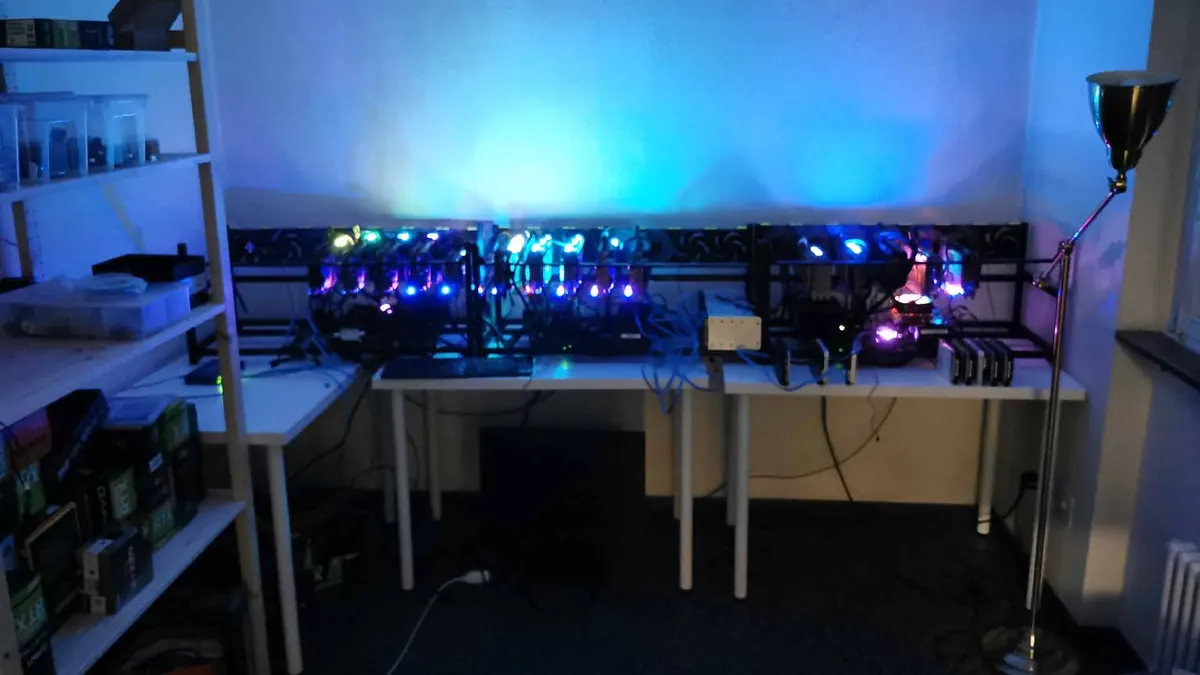
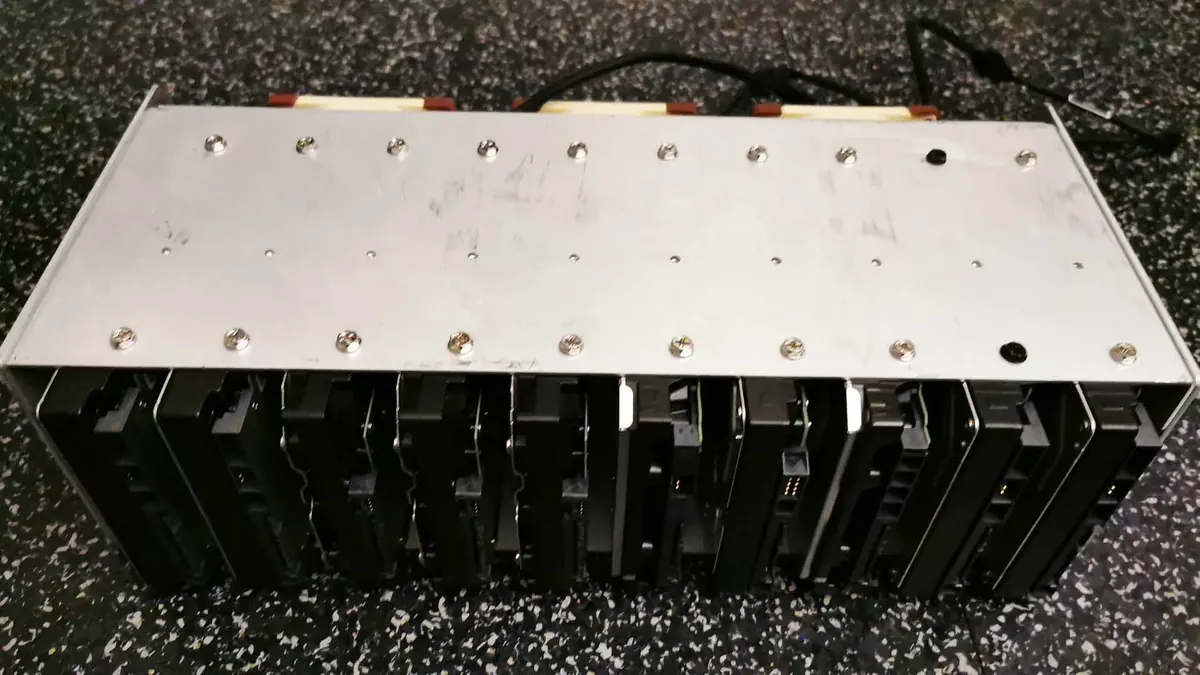
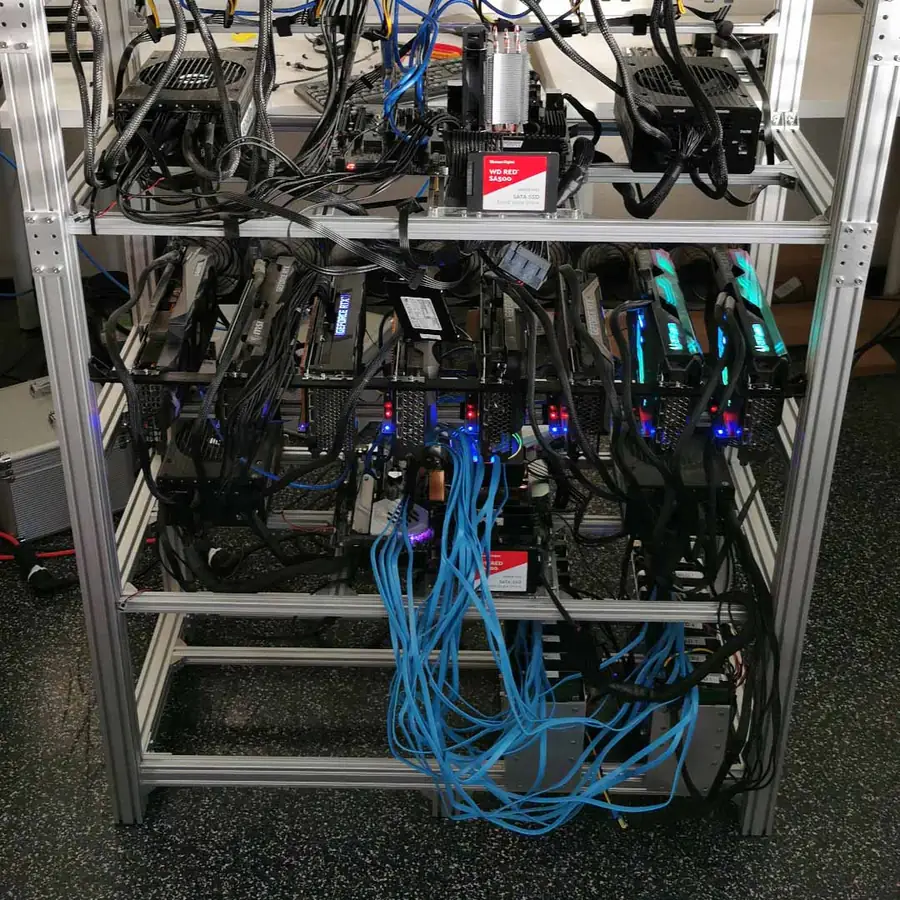
I burnt my fingers a little on these altcoins, and I cannot recommend going deep into altcoins.
![Screenshot of the GitHub issue "Feature-Idea] mining 2 cryptos with lhr" by forReason in the T-Rex miner repository, 2 October 2021
My proposal on the T-Rex miner's GitHub, 2 October 2021: Ethereum in LHR mode, and a second coin such as Ravencoin on the rest of the card.
In 2021, NVIDIA limited the hashrate of its new graphics cards for Ethereum mining (LHR, Lite Hash Rate). The card throttled itself as soon as it recognised Ethereum mining. On 2 October 2021 I proposed to the developers of the T-Rex miner a way around it: mine Ethereum in LHR mode and fill the rest of the card with a second coin such as Ravencoin, rotating between the two.
Five days later, T-Rex shipped it as "LHR unlock dual mining" in version 0.24.0, and other miners followed. LHR cards got about 80% of their power back. That saved GPU mining for the whole community, until Ethereum moved to proof of stake in September 2022 and Ethereum mining was abandoned for good.
Today I mine only bitcoin again, and with small devices. Here is what they are for.
When mining at home pays and when it does not
A miner turns electricity into two things: bitcoin and heat. How much bitcoin depends only on its computing power and that of the whole network. On 14.11.2026, 1 TH/s, one trillion attempts per second, earned about 46 satoshi a day in a pool. At the floor of about CHF 56’500 per bitcoin, that is 2.6 Rappen.
A Swiss household pays a median 27.7 Rappen per kWh (ElCom 2026). If you buy that electricity only for the bitcoin, even an efficient small miner uses far more of it than its bitcoin are worth. Then buying bitcoin is the better deal. That holds for my devices too, as the calculation below shows.
But energy is never lost. Practically every kWh a miner draws comes out as a kWh of heat, exactly as from an electric heating element of the same power. Where you heat with electricity anyway, the miner gives the same warmth for the same electricity, and the computing work comes free on top. Two conditions: it replaces an electric heater, not a gas heating or a heat pump, which make a kWh of heat far more cheaply. And the miner has to be quiet enough for the room: professional machines are as loud as a vacuum cleaner, small heater miners like my Nano 3S are not.
The same thinking applies wherever the money is spent anyway: on solar power that would otherwise go to the grid for little, or on lottery tickets. That is why I run miners for three uses, and Hans for a fourth.
Use 1: the Bitaxe as a statement and a learning project
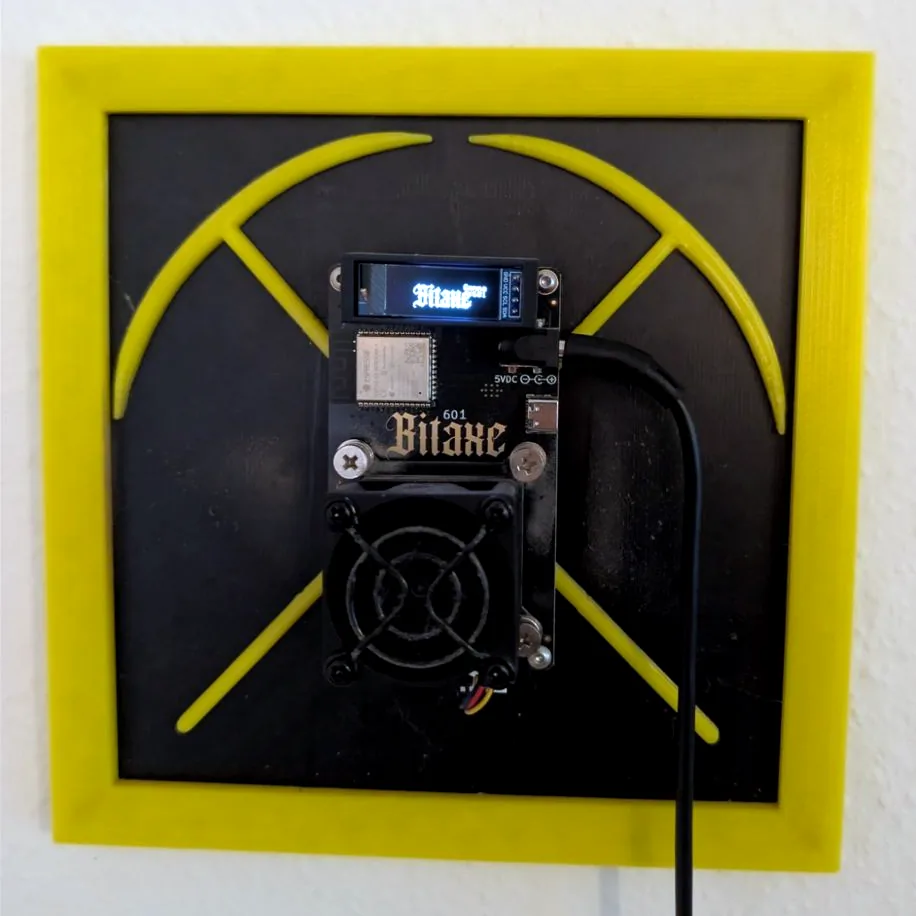
The Bitaxe is a small open-source miner. Its hardware and software are open, built by the community. It does about 1.2 TH/s and uses about as little power as a phone charger, around 17 watts. It is quiet enough for the living room.
For me it is above all a statement: bitcoin is not only mined in big halls but also on my wall. Every small miner that chooses its own pool spreads the network's computing power a little wider. With it I support the community that develops these devices.
And it is a great learning project. With a Bitaxe you can learn what hashrate, pool, difficulty and share really mean, instead of only reading about them. How pools combine and pay out the work of many small miners is explained in Mining pools. With a Bitaxe you can also hope for a whole block on your own, as in solo mining, but the chance is tiny.
On household power it does not pay financially: valued at the floor, it finds bitcoin worth about CHF 11 a year, while its electricity costs about CHF 41. For me that is the price of a hobby that showed me bitcoin from the inside.
Use 2: solar power from the roof that nobody pays well for
My dad has solar panels on his roof. He cannot use much of their power himself, especially around midday in summer. Feeding it into the grid earns little: since 2026, Swiss systems under 30 kW get a minimum of 6 Rappen per kWh. On top come registration, billing with the utility and declaring the payments on the tax return. For a small system, that is a lot of effort for little money.
A small miner simply takes this surplus, no forms needed. Valued at the floor, it earns per kWh:
| As of 14.11.2026, at the floor | Sats per kWh | Francs per kWh |
|---|---|---|
| Bitaxe 601 (about 1.2 TH/s, 17 W) | about 135 | 7.6 Rp. |
| Avalon Nano 3S (about 6 TH/s, 140 W) | about 82 | 4.6 Rp. |
| Minimum feed-in tariff | 6.0 Rp. |
At the floor, mining is roughly level with feeding in. When the price is above the floor, as it almost always has been in bitcoin's history, the kWh in the miner is worth more. The difference from household power is what matters: for solar power that would otherwise go for 6 Rappen, the miner is a sensible use. For power at 27.7 Rappen, it is not.
These are today's figures. As the network grows, a miner's sats per kWh fall: over six years they average about a third of today's. Whoever feeds the power in and buys bitcoin with the tariff and with the miner's price ends with several times as many sats, for the Nano 3S about 3.6 times. What remains for the miner is that it needs no forms (research paper on home mining, section 6).
The catch: the sun delivers mostly in summer and at midday. A miner that runs only then stands idle the rest of the time. How to tie it to the surplus and what happens in winter is worked out in Bitcoin mining with solar power.
Use 3: a miner instead of the towel heater
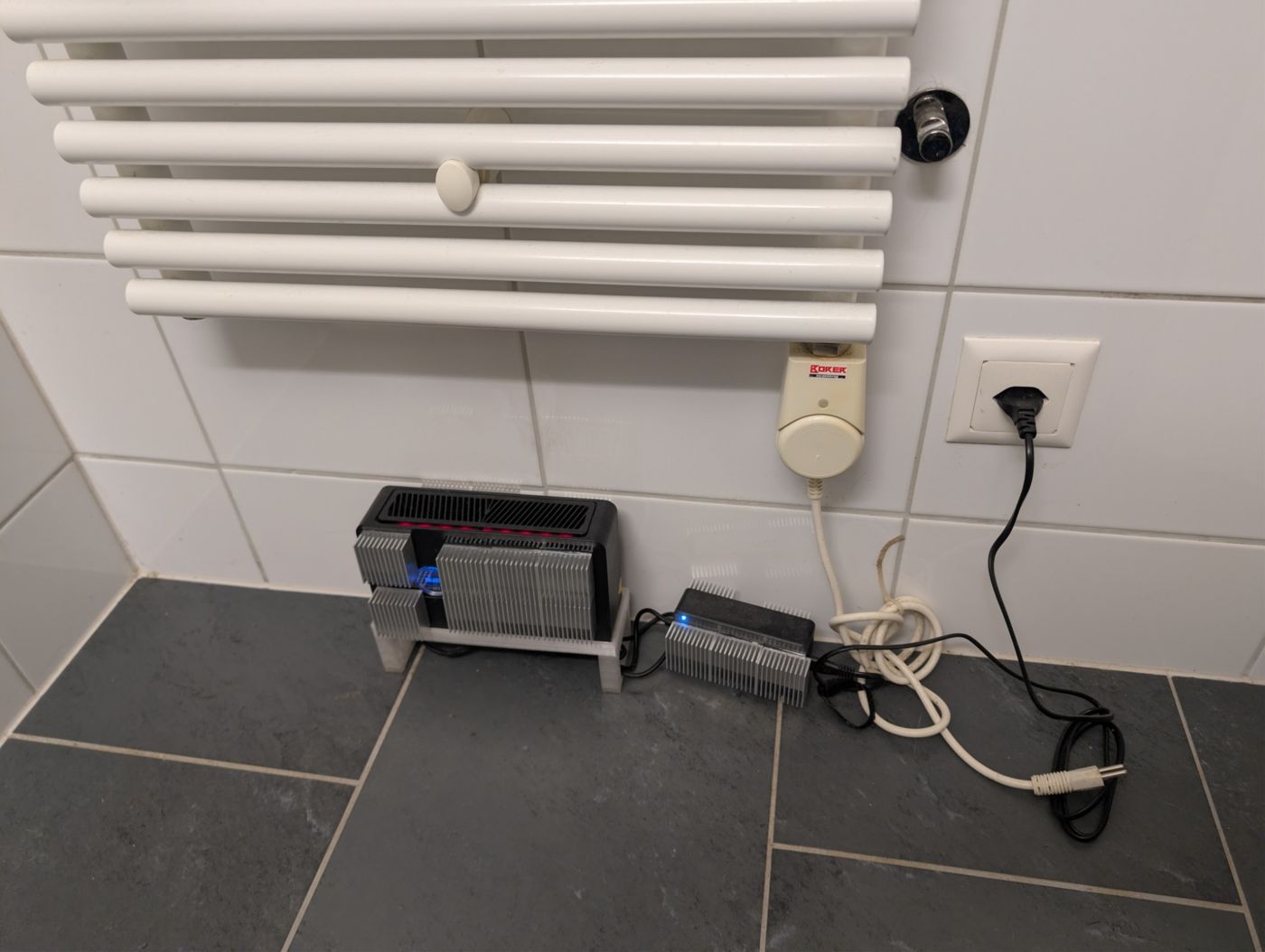
In the bathroom I had an electric towel heater. That thing was a power monster: it drew about 800 watts, more or less all the time. I switched off the heating element and put a small Canaan Avalon Nano 3S underneath. The Nano 3S is a miner built as a space heater: about 6 TH/s at 140 watts, quiet enough for a flat. Its warm air rises straight through the radiator.
I modified it slightly: I glued extra heatsinks onto the miner and especially onto the power supply. Cooler parts last longer, and in devices like this the power supply is often the first part to fail.
The result: the miner uses less than a fifth of the old heating element and still dries my towels. A bigger miner would do it a little better still.
| As of 14.11.2026, 27.7 Rp./kWh | Old heating element | Avalon Nano 3S |
|---|---|---|
| Power | 800 W | 140 W |
| Electricity per day | 19.2 kWh | 3.4 kWh |
| Electricity cost per year | about CHF 1’940 | about CHF 340 |
| Mined bitcoin per year, at the floor | – | about CHF 57 |
The towels get dry either way. The difference of about CHF 1’600 a year is my saving, and the bitcoin come on top.
Use 4: solo mining as a 100-dollar lottery ticket
Hans, with whom I run this site, likes a fourth use: solo mining. A small miner for about 100 dollars then does not work in a pool for a steady share but alone, for a whole block. Most of the time it finds nothing. If it does find a block, the whole reward is its own: today 3.125 new bitcoin plus fees, about CHF 178’000 at the floor. After the 2028 halving it is half, at a floor that will be higher by then.
Hans sees it as a lottery ticket that runs for four to six years, as long as such a device lasts. The chance for a Bitaxe with 1.2 TH/s, if the network's hashrate stays as it was on 14.11.2026:
| Bitaxe with 1.2 TH/s, solo | Chance of at least one block |
|---|---|
| in 1 year | about 1 in 14’400 |
| in 4 years | about 1 in 3’600 |
| in 6 years | about 1 in 2’400 |
| Swiss Lotto jackpot, per line | 1 in 31.5 million |
A device with 6 TH/s like my Nano 3S has five times the chance. If the network's hashrate grows, the chance gets smaller: as our hashrate model expects it to grow, the Bitaxe's chance is about 1 in 16’300 in the first year and 1 in 4’900 in six years.
On average, solo mining earns exactly as much as the pool, just all at once or not at all. But is it really better than lottery tickets? I checked it with the same cautious numbers. Valued at the floor, a solo miner for about 100 dollars (CHF 85) with 1.2 TH/s finds about CHF 40 to 75 of bitcoin on average in five years, depending on how fast the network grows. Our hashrate model expects the lower end. Against that stand the device and its electricity:
| Over 5 years, valued at the floor | Stake | Back on average per franc |
|---|---|---|
| Swiss Lotto | any | about 50 Rp. |
| Solo miner on household power, 27.7 Rp./kWh | about CHF 290 | about 15 to 25 Rp. |
| Solo miner on solar surplus, 6 Rp./kWh forgone | about CHF 130 | about 30 to 60 Rp. |
| Solo miner heating a room you heat electrically anyway | about CHF 85 | about 45 to 90 Rp. |
So Hans is right wherever the miner's electricity is spent anyway: then it returns about as much as the lottery, more if the network grows more slowly than our model expects, and at any price above the floor more still. With household electricity bought only for the miner, the lottery returns more on average. The chance of the big win clearly speaks for the miner: one Swiss Lotto line twice a week for five years costs CHF 1’300 and has a chance of about 1 in 60’000 at the jackpot. The CHF 85 miner has about 1 in 5’200 at a whole block with the network growing as our model expects, twelve times the chance for a fifteenth of the stake. A block is worth less than a typical jackpot, but unlike a lottery ticket, the miner also helps secure the network.
How often small solo miners really win and how to start is in Solo mining: the bitcoin lottery. The chance for your device is in the solo mining calculator.
Why miners at home keep bitcoin decentralised
Bitcoin is only as hard to control as its mining is spread out. Today a handful of big pools find most blocks, and in a normal pool it is the pool, not the miner, that decides which transactions go into a block. A miner at home that mines solo on its own node, or in a pool where miners build their own blocks, puts that decision back into many hands. Computing power spread over many homes in many countries is also harder for any single government, company or power grid to switch off.
One home miner is tiny against the whole network. But the network is the sum of such decisions, and a heater, a solar roof or a lottery budget makes it a decision that costs little or nothing extra.
How the miner pays off, valued at the floor
You can make mined bitcoin look good by assuming a high price. I prefer to value them cautiously at the floor: the line in the Power Law model that the price has so far fallen below only briefly. On 14.11.2026 it was at about CHF 56’500, and the price stood right on it. The floor rises over time; by the model, to about CHF 77’000 by November 2027. How it is calculated is in the methodology.
| Valued at the floor, as of 14.11.2026 | Bitaxe 601 | Avalon Nano 3S |
|---|---|---|
| Purchase price, approximately | CHF 150 | CHF 300 |
| Mined per year, at today's floor | about CHF 11 | about CHF 57 |
| Electricity cost per year | about CHF 41 | about CHF 340 |
| Paid for by mining alone, electricity not counted | around 2035 | around spring 2031 |
| Paid for as a replacement for the towel heater | – | after about 70 days |
This is how I read the table:
- On household electricity bought only for mining, neither miner pays off. At the floor, the Nano 3S finds only about a sixth of what its electricity costs. For CHF 340 of electricity a year I could buy about 600’000 sats; the miner finds about 100’000.
- As a heater, its electricity is paid for anyway, because I need the heat regardless. Then every mined sat is extra income. Valued at the floor, that income slowly pays off the purchase price, in just over four years. With CHF 1’600 of saved electricity per year, it was paid for after just over two months.
- The halving in spring 2028 halves the income. The rising floor makes up part of that. If the network's hashrate grows, paying it off takes longer.
How I calculate it
Pool income on 14.11.2026: difficulty 134.8 trillion, average reward of the last 144 blocks 3.154 BTC.
Sats per TH/s per day = 10¹² × 86’400 ÷ (difficulty × 2³²) × 3.154 BTC × 100’000’000 ≈ 47, after a 2.5% pool fee ≈ 46
Nano 3S: 6 TH/s × 46 ≈ 275 sats a day ≈ 100’000 sats a year. At the floor of CHF 56’500: 0.001 BTC × CHF 56’500 ≈ CHF 57.
Nano 3S electricity: 0.14 kW × 24 h × 365 × CHF 0.277 ≈ CHF 340. Old heating element: 0.8 kW × 24 h × 365 × CHF 0.277 ≈ CHF 1’940. Saving ≈ CHF 1’600 a year, about CHF 4.40 a day. CHF 300 ÷ CHF 4.40 ≈ 68 days.
Paying off through mining: day by day, the sats times that day's floor, until CHF 300 is reached. Floor = 0.42 × 10^(−16.493) × days since 03.01.2009^5.688 dollars, in francs at today's exchange rate. Half the sats from the halving around 12.04.2028. Network hashrate the same as today.
Per kWh: Nano 3S 275 sats ÷ 3.36 kWh ≈ 82 sats, at the floor 4.6 Rp. Bitaxe: 1.2 × 46 ≈ 55 sats ÷ 0.41 kWh ≈ 135 sats, at the floor 7.6 Rp.
Solo mining: expected blocks per year = 1.2 TH/s ÷ 908’000’000 TH/s × 52’560 ≈ 0.0000695. Chance of at least one block in n years = 1 − e^(−0.0000695 × n): after 1 year 1 in 14’400, after 4 years 1 in 3’600, after 6 years 1 in 2’400.
Solo miner against the lottery: 1.2 TH/s × 47 sats (no pool fee) ≈ 56 sats a day, day by day at that day's floor, half from the halving, over 5 years ≈ CHF 76 with the network as today, ≈ CHF 40 if it grows 30% a year, about what our hashrate model expects. Electricity 0.017 kW × 24 h × 365 × 5 ≈ 745 kWh: at 27.7 Rp. ≈ CHF 205, at 6 Rp. ≈ CHF 45. Swiss Lotto: about half of the stakes are paid out as prizes; one line costs CHF 2.50, 2 draws a week × 52 × 5 = 520 lines ≈ CHF 1’300, chance of a jackpot ≈ 520 ÷ 31.5 million ≈ 1 in 60’000.
My two miners have run since May 2025, through the whole bear market, and the Bitaxe not always around the clock. The price fell sharply in that time and today stands at the floor. That changes little for my calculation, because I value at the floor anyway. The electricity saving in the bathroom does not depend on the price at all.
What I would advise someone in Switzerland
- Do you heat anything electrically, with a fan heater, towel heater or electric radiator? Then check whether a quiet small miner can supply the heat. It does not replace a heat pump or gas heating, but it does replace an electric heater.
- Do you have solar power you do not use yourself? Then a small miner is a simple way to use it, without the paperwork. Feeding it in and buying bitcoin with the tariff gets more sats, though.
- Do you play the lottery? Then a small solo miner on electricity you spend anyway is the better ticket, and it helps keep the network decentralised.
- Do you want to understand how bitcoin works? A Bitaxe is the nicest device for that I know.
- Thinking of mining altcoins? I burnt my fingers on Ethereum and Chia mining and would not go deep into it again.
- Do you simply want more bitcoin, with household electricity bought only for that? Then buy them, for example with a regular savings plan. What to watch for when buying in Switzerland is in Buying bitcoin in Switzerland.
In Switzerland, mined bitcoin are income, valued at the price when they arrive. How they go on the tax return is explained in Bitcoin taxes in Switzerland.
The four uses are worked through for eleven miners, with the figures for Germany, Austria and Switzerland, in the research paper on home mining. Work out your own device with your electricity price:
Frequently asked questions
Is bitcoin mining worth it in Switzerland?
Yes, where the miner runs on electricity you spend anyway: in place of an electric heater it gives the same heat, and the bitcoin come on top. It also pays with solar power that would otherwise earn only the low feed-in tariff. Running it on household electricity at about 28 Rappen per kWh just for the bitcoin does not pay: buying gets you several times as many sats.
Can a bitcoin miner replace an electric heater?
Yes, a miner turns almost all of its electricity into heat. My Avalon Nano 3S draws 140 watts instead of the 800 watts of the old heating element and still dries the towels. That saves about CHF 1’600 of electricity a year. It does not replace a heat pump or gas heating, which make heat more cheaply.
What is a Bitaxe?
A small open-source bitcoin miner with about 1.2 TH/s and around 17 watts. It is quiet, cheap and shows how mining works. It does not make money; its electricity costs more than it finds.
What are the odds of solo mining with a Bitaxe?
With 1.2 TH/s and the hashrate of 14.11.2026, about 1 in 14’400 per year, about 1 in 2’900 over five years. As the network grows, as our hashrate model expects, it is about 1 in 5’200 over five years. A hit brings a whole block, today over 3.1 bitcoin. That is far more likely than a lottery jackpot. On electricity you spend anyway, it also returns about as much on average as the lottery, or more.
Why do you value the mined bitcoin at the floor?
Because that is the cautious calculation. The floor of the Power Law model is the line the price has hardly ever fallen below. Whatever pays off at the floor pays off faster at any higher price. The model describes the past and is no guarantee.
How long until a small miner has paid for itself?
Through mining alone, valued at the floor and without electricity costs, an Avalon Nano 3S for about CHF 300 needs just over four years, as long as the network does not grow much. As a replacement for an 800-watt electric heater, its electricity savings paid for it after about 70 days.
Sources
- mempool.space: difficulty, hashrate and reward of the last 144 blocks, retrieved 14.11.2026
- ElCom: electricity tariffs 2026, household median
- ElCom: FAQ on the minimum remuneration for photovoltaics from 2026
- Canaan: Avalon Nano 3S
- [T-Rex miner: "Feature-Idea] mining 2 cryptos with lhr", issue #670, 2 October 2021
- T-Rex miner 0.24.0: LHR unlock dual mining mode, 7 October 2021
- Bitaxe: open-source hardware
- Price and floor: Power Law page of bitcoin-powerlaw.com, as of 14.11.2026
- The author's own measurements and photos, May 2025 to November 2026
Not financial, legal or tax advice. Models are no guarantee.
The Bitcoin Power Law newsletter
An email when we publish a new article or calculator. Every issue has a one-click unsubscribe link.